A factory switch room: a row of distribution panels with digital power meters showing readings on the panel doors
SOLUTIONS · FACTORY POWER

Factory Power Monitoring: From Demand Alerts to Carbon Accounting Data

Contract-capacity overruns often go unnoticed until the bill arrives. Three short clips show how meters connected to CGate warn you before demand reaches contract capacity, show where the power goes, and keep the power records carbon accounting calls for.

Published
THREE MOMENTS

Three moments in a factory’s power use

Taipower determines overruns from the month’s highest 15-minute average demand and bills the excess at two to three times the basic rate. The three clips below show how each situation plays out with power monitoring in place. All values shown are illustrative.

Demand approaching contract capacity

BEFORE

You only find out from the monthly bill that demand went over last month.

AFTER

If the meter provides a demand value, CGate reads it directly. When demand stays near the set threshold for the configured time, the CGate web page flags it and emails the person in charge.

Circuit-level power monitoring

BEFORE

The bill shows a single total, with no way to tell where the power went.

AFTER

Each circuit is logged hourly, and the CGate web page makes it plain: at 2 a.m., with no one in the room, one circuit is still drawing power.

A customer asks for power-use data

BEFORE

Someone digs out a year of bills and compiles them by hand, and even then they only have a plant-wide total.

AFTER

A remote energy-management or carbon-accounting system can read each circuit’s power data straight from CGate and allocate it by production line.

CARBON ACCOUNTING

Power data for carbon accounting

More and more supply-chain customers ask their suppliers for power-use and emissions data. For most manufacturers, purchased electricity is a major emissions source.

Plant-wide totals: the bill is enough

Emissions from purchased electricity are usually calculated as monthly kWh multiplied by the grid emission factor. For a plant-wide figure, the power bill is enough.

Per production line: you need circuit logs

If a customer wants the figure for one production line, you need hourly logs per circuit to allocate it. CGate logs every circuit, so power use can be split by line.

Every figure traces back

The figures come from hourly meter readings, and logging continues even when the network is down. A remote energy-management or carbon-accounting system can also read them straight from CGate over Modbus TCP or MQTT.

CGate supplies the power data. It doesn’t apply emission factors or produce the inventory report; that still follows your chosen standard or your verifier’s requirements.

ARCHITECTURE

System architecture and devices

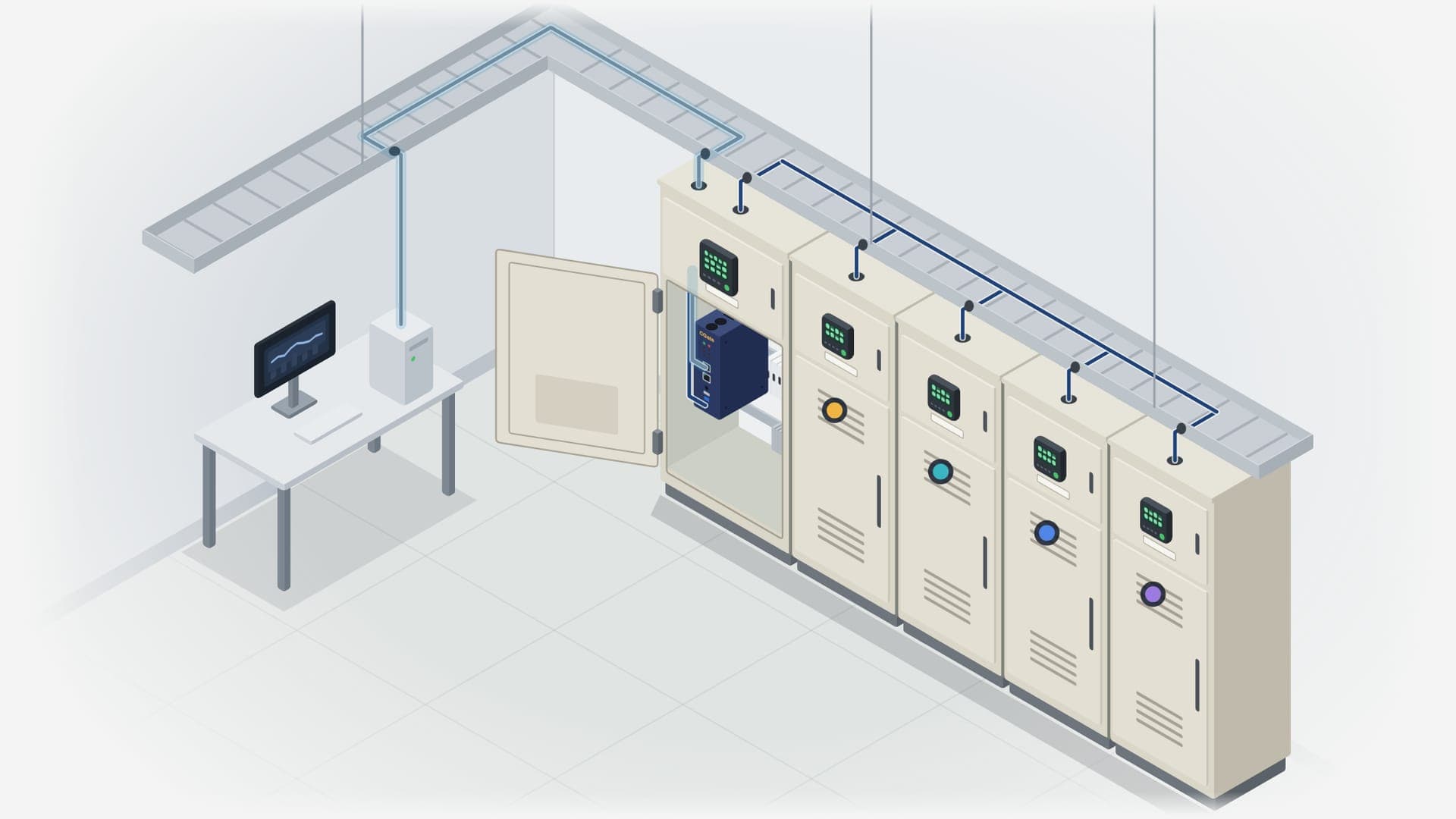
Behind all three moments is one system: a multifunction meter on the main incomer and a meter on each branch circuit, daisy-chained over RS-485 to a CGate inside the panel. CGate logs every reading and provides a web interface and email alerts over the local network.

Factory power monitoring architecture: a row of panels in the switch room, with the main incomer meter and four branch meters (air compressor, air conditioning, Line A, Line B) daisy-chained over RS-485 to a CGate in the panel, linked over the LAN to an office computer
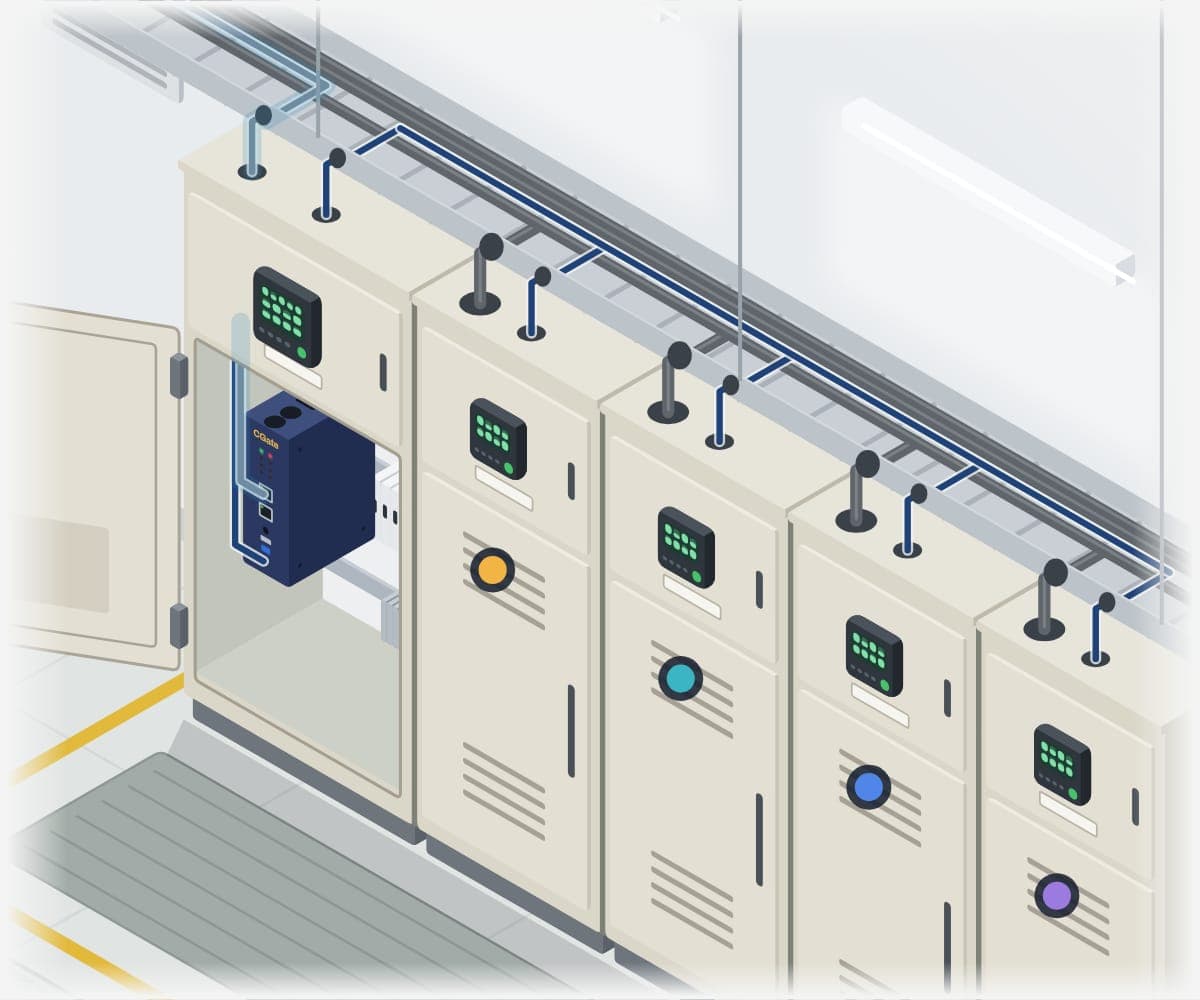
Close-up of the factory power panel: main incomer and branch meters on the door, with the CGate and RS-485 daisy-chain wiring inside
Main incomer meterMeasures plant-wide power and demand through CTs; connected to CGate over RS-485
Branch-circuit metersOne each for the air compressor, air conditioning, Line A and Line B, daisy-chained over RS-485
CGateReads the meters, logs continuously to its built-in database, and provides a web interface and email alerts

CGate

Reads the meters, logs continuously to its built-in database, and provides a web interface and email alerts

RS-485 (meters to CGate)
Network cable

CGate

GATEWAY
  • Connects directly to Modbus power meters; pick a model by how many meters you have
  • Built-in database logs continuously, even offline, and can be exported
  • Web interface for viewing; email alerts when demand nears the threshold
View CGate products

4G connectivity

OPTION
  • No network cable in the switch room? Use cellular for viewing and alerts
  • Sends SMS alerts
  • Optional on CGate-05/06

Modbus power meter

METER
  • Any off-the-shelf meter with RS-485 and Modbus
  • CGate reads the points you set up from the meter’s register map
  • If the meter provides a demand value, CGate reads it directly
FAQ

Questions before you start

Can branch meters replace the utility’s billing meter?

No. Billing is always based on Taipower’s meter. Meters you install yourself show where power is used across the plant and warn you early as demand approaches contract capacity.

Can equipment be shut off automatically after an alert?

CGate itself handles monitoring and notification. For automatic load shedding under set conditions, pair it with our RIO series, which switches loads through a relay module and is planned around your site.

Can we use our existing meters?

If they have RS-485 and support Modbus, yes. They connect using their register maps, so there’s no need to replace them.

Will the log be lost if the network goes down?

No. CGate keeps logging on site, and the records can still be exported once the network is back. If the switch room has no network cable, 4G is available as an option.

Can the power log be used directly for carbon accounting?

It can serve as a source of Scope 2 power data and be allocated by circuit to each production line. The inventory report itself still has to follow the standard you use or your verifier’s requirements.

TAILORED TO YOUR SITE

Every plant’s power distribution is different

Meter count, circuit layout, alarm conditions and notification methods (such as LINE) can all be tailored to your site. Tell us about your panels and power use, and our sales team will help you plan the setup.

Contact us